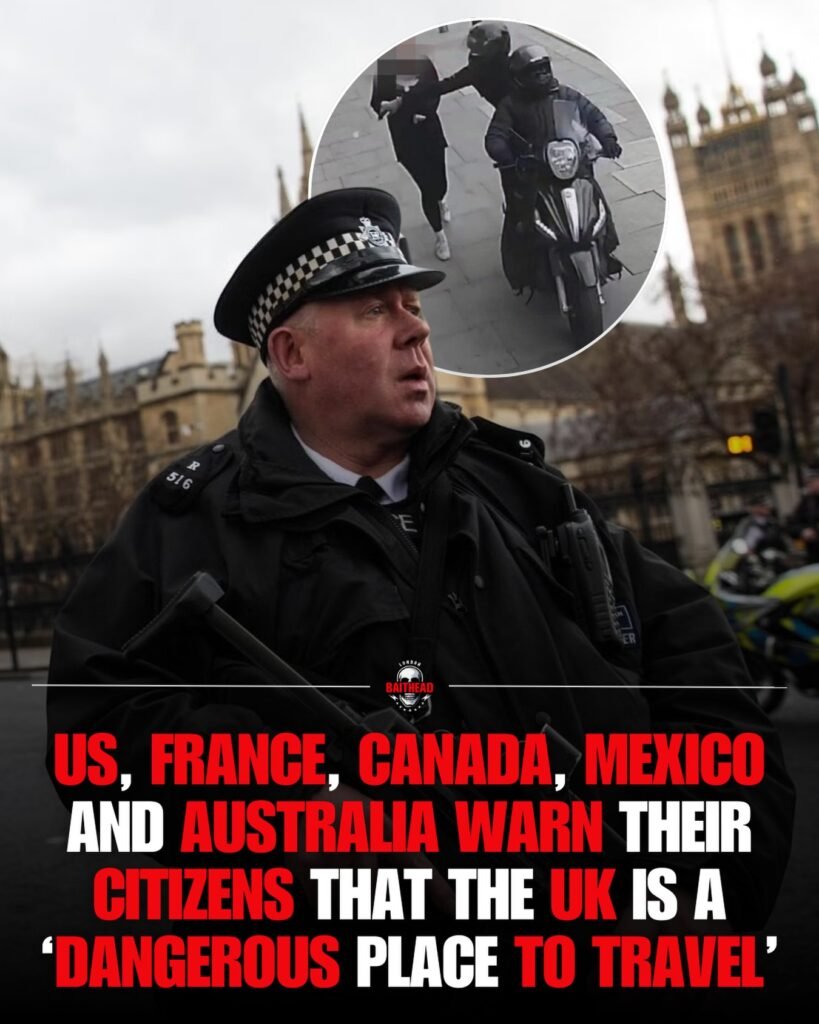
The image presents a dramatic and unsettling message. In the foreground, a British police officer stands alert near a major landmark in London, symbolizing authority and public order. Above him, a circular inset shows a violent street robbery involving masked individuals on a motorcycle. Bold red and white text declares that the United States, France, Canada, Mexico, and Australia have warned their citizens that the United Kingdom is a “dangerous place to travel.”
At first glance, the image feels urgent and alarming. It taps into real anxieties about crime, public safety, and urban violence—issues that many countries, not just the UK, continue to grapple with. The use of strong colors, capital letters, and a shocking visual is clearly designed to provoke an emotional reaction and encourage rapid sharing.
However, the image functions more as a piece of sensational media than a complete or verified account. While governments do periodically update travel advisories, such warnings are usually nuanced, region-specific, and comparative—not blanket declarations that a country is unsafe. The image simplifies a complex reality into a single, fear-driven narrative.
The inset robbery scene plays a crucial role in shaping perception. By isolating one violent incident and placing it alongside a national symbol, the image implies that such acts define everyday life in the UK. In reality, crime—while serious—varies by location and context, and millions of people live, work, and travel safely across the country every day.
This image highlights a broader issue in the digital age: how fear can be amplified through selective visuals and headlines. Social media often rewards outrage and shock over accuracy and balance. As a result, public understanding can be shaped more by viral posts than by data or official sources.
Ultimately, the image is less about travel safety and more about how narratives are constructed. It reminds viewers of the importance of critical thinking—questioning sources, seeking context, and resisting the urge to accept dramatic claims at face value. In a world saturated with powerful imagery, understanding reality requires looking beyond the headline.