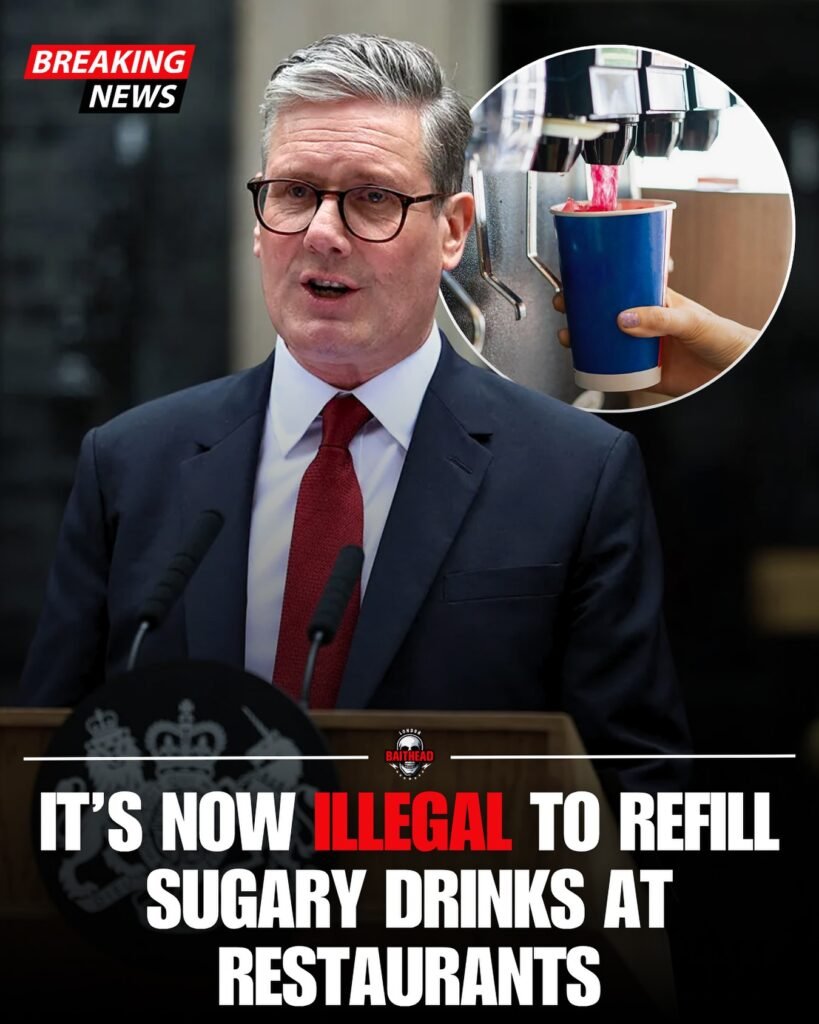
A widely shared image on social media shows a senior British political figure speaking at a podium, paired with bold text declaring that it is now illegal to refill sugary drinks at restaurants. An inset image of a soda fountain pouring a bright-colored drink reinforces the message, giving the post the appearance of urgent, authoritative news. As with many viral visuals, however, the image raises more questions than it answers.
At first glance, the design closely resembles a breaking-news alert: strong red and white typography, a serious-looking official, and a clear public-health angle. Sugary drinks have long been linked to obesity, diabetes, and other health concerns, so the claim feels plausible—especially amid ongoing debates about sugar taxes, portion limits, and nutrition policy. This plausibility is precisely what helps such images spread quickly.
Yet the image itself provides no context. It does not specify a country, a date, or the exact law being referenced. In reality, policies around sugary drinks vary widely by region. Some cities and countries have introduced sugar taxes, restrictions in schools, or guidelines for portion sizes, but a blanket nationwide ban on refilling sugary drinks at restaurants is not universally in effect. Without clear sourcing, the image blurs the line between policy discussion and misinformation.
The presence of a recognizable political figure adds to the confusion. Viewers may assume the claim is official simply because it appears alongside someone associated with government authority. This tactic—pairing real people with oversimplified or exaggerated headlines—is a common feature of viral political content.
Ultimately, the image serves as a reminder of how easily complex public-health debates can be reduced to eye-catching slogans. While concerns about excessive sugar consumption are real and widely supported by medical research, sweeping claims presented without evidence can mislead rather than inform. As such images circulate, they highlight the importance of checking reliable news sources before accepting or sharing “breaking” claims that appear too simple to capture the full truth.