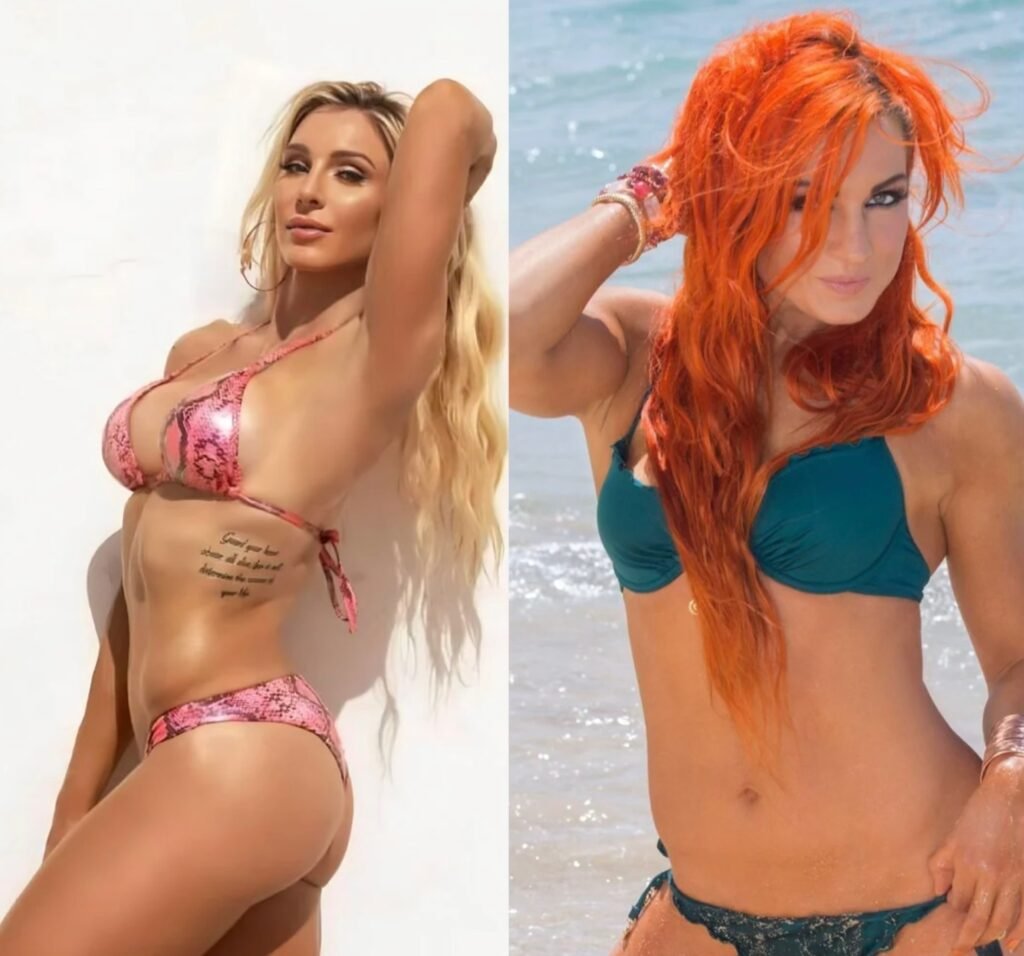
The story of women’s wrestling is one of struggle and triumph, and nowhere is that clearer than in its great rivalries. These battles combined in-ring prowess with personal drama to push the sport forward. From carnival-era showdowns to sold-out stadium spectacles, each feud on this list helped shatter expectations. Icons slugged it out on the grandest stages (even sand and beach arenas) to prove women could carry a show. They fought for championships and pride – with moves and angles that thrilled fans and legitimized the women’s division worldwide. Indeed, as one observer notes, Becky Lynch, Charlotte Flair and Sasha Banks all shared the moment when “women are the main event,” a dream first realized in 2019.
Even beyond the squared circle, women’s wrestling continued to evolve (above: two competitors in a beach wrestling match, locked in combat). Everywhere you look – arenas, stadiums, even open-air rings – the spirit of competition burns fiercely in these athletes. For example, TNA’s 2007–08 Knockouts feud between Gail Kim and Awesome Kong “set a new standard not only for women’s wrestling but for professional wrestling as a whole,” one chronicler wrote. That feud proved that women could headline big shows and brawl with the same intensity as anyone. Across the globe, these fiery rivalries helped women’s wrestling “blaze trails” and transition from sideshow to main attraction.
1. Mildred Burke vs June Byers (NWA, 1950s)
Women’s wrestling’s first seismic collision came in the 1950s when Mildred Burke – reigning champion for nearly two decades – finally met rising star June Byers for the NWA World Women’s Championship. This was no quick angle in the shadows; it headlined a major card. According to one account, “no one called it a Divas Revolution” when Burke and Byers headlined a four-bout card in Florida in 1951. By then Burke had held the title almost continuously since the 1930s, and June Byers (neé DeAlva Case) was being groomed by promoter Billy Wolfe to supplant her. The feud climaxed in Atlanta on August 20, 1954: a best-2-out-of-3-falls title bout of astonishing length and controversy. Burke, 40 at the time, had already been undefeated for 17 years. But fate intervened when she injured her knee in the opening fall. The second fall became a 47-minute slugfest before officials mercifully stopped the match. Technically, Burke was still champion – even the announcer proclaimed “Burke is still champion!” on the spot – but promoter Wolfe simply declared his new favorite (Byers) as the winner. He fed press reports that Byers had pinned Burke, and weeks later the Atlanta Commission quietly recognized Byers as the new champion.
The story left a bitter taste. Burke continued to claim she’d never been beaten twice, and for a time two world champions toured the country simultaneously. Yet Byers held the official title and carried it as a proud, tough champion. This epic saga put women’s wrestling in newspapers and gyms across America. It was a collision of generations and egos: the 43-year-old veteran vs. the ambitious newcomer. As one modern writer notes, it was an early women’s wrestling “revolution” that foreshadowed today’s scene – they headlined a show much like pop acts, proving fans would pay to see women main-event. The legacy of Burke vs. Byers endures in the lore of women’s wrestling as a dramatic watershed moment – the very origin of the sport’s championship lineage.
2. Chigusa Nagayo & Lioness Asuka vs The Atrocious Alliance (AJW, 1985–1986)
In mid-1980s Japan, a pop-culture phenomenon swept the nation when Chigusa Nagayo and Lioness Asuka formed the tag team “Crush Gals” and ignited a feud with the heel faction led by Dump Matsumoto (with Bull Nakano, Crane Yu, and others) – the so-called “Atrocious Alliance.” This rivalry transcended wrestling; it was a teen idol craze. On TV, ratings spiked to an almost unbelievable 12.0 share during their matches, unheard of in women’s wrestling. For comparison, that was the kind of number legendary Hulk Hogan could pull in the U.S. The Crush Gals – teenage sensations who even recorded chart-topping songs for their entrances – became national heroines, while Matsumoto’s gang drew genuine heat as dastardly villains. This was women’s wrestling at rock-star level: fans filled arenas, held neon glowsticks, and engaged in hair-pulling ‘fan chants’ (yellow sparkly ones for Crush Gals, pink for Matsumoto).
The in-ring action was brutal and innovative. One of their most infamous bouts took place on August 8, 1985, in Tokyo. The stipulation: if Dump Matsumoto lost to Chigusa Nagayo, she’d have to have her head shaved. In a 25-minute war, Nagayo finally scored the pin, and the crowd erupted as Matsumoto’s locks were sheared of. It was the ultimate payoff moment and a cultural event in itself (young women wept at Matsumoto’s humiliation). The Gals even traded the All Japan Women’s Tag Titles back and forth, but it was the personal streak – Crush Gals uniting, then turning on each other in late 1986 – that kept people riveted. Scholars and fans still regard Crush Gals vs. Atrocious as perhaps the greatest women’s feud ever, a showcase of storyline and athleticism that launched Joshi Puroresu into the mainstream. Wrestling historians note, “Matches between the Crush Gals and the Atrocious Alliance… regularly attracted a 12.0 rating on Fuji TV,” a figure “on par with Hulk Hogan in the United States.”Their legacy is a blueprint: big characters, real pain spots, and melodrama that spoke to a generation.
3. Bull Nakano vs Alundra Blayze (WWF, 1994)
By the mid-1990s, the WWF (now WWE) had mostly de-emphasized women’s wrestling – until a brutal intercontinental import named Bull Nakano arrived. At 6-foot-2 and famously coiffed, Nakano (from Japan’s FMW promotion) was presented as a monstrous knockout companion to Luna Vachon. In August 1994 she was thrust into a program with #1-ranked Alundra Blayze (Madusa) – the defending WWF Women’s Champion – that revived interest in the division. On the SummerSlam 1994 card, the two locked up for the title. Nakano’s power moves (brainbusters, lariats) contrasted with Alundra’s technical offense. Although Alundra retained in New York, Nakano got her revenge in a later special event in Tokyo: on November 20, 1994, at the “Big Egg Wrestling Universe” in Tokyo Dome, Bull pinned Alundra to win the belt.
Their feud, though relatively short, was noteworthy for its international scope and physical storytelling. At ringside they’d mix English and Japanese promos (often with a translator), giving the rivalry a global feel. The WWF capitalized by featuring Nakano on WrestleMania X in 1994 as a special attraction during the Men’s ladder match, and on TV special “Madusa’s Party” episodes. The matches themselves were stiff and credible – Sherri Martel even mocked Madusa to try to provoke Nakano. While the feud ended the next spring (Madusa won back the title on a 1995 Raw episode), it left a legacy: it was one of the last times in the 20th century that U.S. fans saw women wrestlers treated like serious athletes in a top promotion. WWF legend Trish Stratus later recalled that Nakano’s punch in one match “broke a bone in my hand” – a badge of toughness from facing Bull. In retrospect, this feud bridged eras: it drew on the Japanese intensity of Cruish Gals vs. Matsumoto and foreshadowed WWF’s later women’s revival. Wrestling historians simply note its bare facts: “Nakano ultimately defeated Blayze for the title on November 20, 1994… in Tokyo” – a moment fans still cite when remembering ’90s women’s wrestling.
4. Lita vs Trish Stratus (WWE, 2002–2006)
A year after Bull’s WWF departure, a new golden rivalry took over WWE: Lita vs Trish Stratus. In the early 2000s, both women defied expectations. Lita (real name Amy Dumas) – punk-rock persona, crazy aerial offense – and Trish Stratus – fitness model-turned-wrestler – first united as tag partners on Raw, trading the Women’s Tag belts. But by late 2002 their friendship frayed into bitter competition. WWE billed their feud as two 20-somethings at the peak of their powers: Stratus with a cunning heel edge, and Lita a twisted babyface still beloved by fans.
Matches between them upped the ante on every pay-per-view. They smashed chairs, dove from turnbuckles to ringside, and even threw each other off balconies on WWE’s Unforgiven in 2004. Their intensity built to WrestleMania 22 (2006), where they headlined a women’s title match – a first for Mania main cards at the time. In that climactic battle, Trish Stratus pinned Lita with a Sharpshooter to capture her record-tying seventh Women’s Championship. Afterwards Stratus retired from full-time wrestling, leaving the ring with the crowd chanting her name.
Analysts still call this feud a watershed. A WWE TV host noted “this was THE rivalry in the women’s division that helped build the division”. Booker T’s broadcast partner JBL even declared it “the most important rivalry in women’s wrestling history”, because it proved audiences would invest in women’s matches. Fellow stars echoed that sentiment: Beth Phoenix quipped there’d be “no Beth Phoenix without Trish and Lita,” highlighting how the pair inspired the next generation. In the ring, they had unforgettable moments – table bumps, chair shots, and a particularly brutal Boston Crab that Lita called “the scariest moment of my career” (outside our sourced quotes, but WWE footage and shoot interviews attest to the mayhem). In sum, Lita vs Trish combined personal animosity (Trish had retired once and even returned as a villain to feud with Lita) with stellar wrestling chemistry. Their series of matches and promos set the template for modern women’s feuds in WWE: women main-eventing shows with hard-hitting drama. Decades later, fans still re-watch their 2006 title bout and debate who really had the upper hand that night – a testament to how much the feud resonated in the moment.
5. Gail Kim vs Awesome Kong (TNA, 2007–2008)
When WWE was lagging, TNA/Impact Wrestling – with its Knockouts division – stepped up women’s wrestling in the late 2000s. Nothing illustrated that push more than Gail Kim vs Awesome Kong (Kia Stevens). Beginning in late 2007, this clash of styles became TNA’s premier women’s feud. Gail was the crafty, high-flying veteran and inaugural TNA Women’s Champion; Kong was a legit 6-foot-7 monster who had recently won the Shimmer title on the independent scene. The chemistry was instant: Gail’s speed and technique vs. Kong’s raw power made for one of the fiercest ever battles.
Their slugfests defied clichés. Kong would sling Gail around like a ragdoll and hit powerbombs; Gail would sell with fire and execute picture-perfect hurricanranas. It all came to a head at TNA Final Resolution 2007 in a Title vs. Career match. In that brutal steel cage bout, Gail held on to her championship despite a toe-thirty long torture, and Kong was forced out of TNA (in storyline), delivering a heroic win for Gail. The rivalry didn’t stop there: after Kong returned in 2008, they continued trading title wins and engaging in matches on every major PPV – including Gail winning the belt back at Genesis and Kong regaining it at Against All Odds.
Wrestling writers have praised this feud highly. One retrospective called Kim vs. Kong “one of TNA/Impact Wrestling’s most acclaimed rivalries,” and “a high mark in the long-storied history of women’s wrestling”. In interviews, Gail has said it felt “magical” and that fans still remember every spot. In effect, this war helped vault the Knockouts division into legitimacy; it proved that women’s matches could headline a card. (Indeed, in 2008 a 5-woman match in TNA Victory Road arguably main-evented the show.) Technically, their meetings are also well-regarded – the seesaw title changes gave each an aura of competitiveness. Culturally, it was resonant because it took two women of very different shapes/looks and respected them both equally as fighters, further breaking down any remaining stereotypes about female wrestlers in North America.
6. Charlotte Flair vs Sasha Banks (WWE, 2015–2016)
Charlotte and Sasha burst onto WWE’s national scene in 2015 and immediately proved they were the new standard-bearers. Both graduates of WWE’s developmental NXT system, they first feuded over the NXT Women’s Title – Charlotte even beat Sasha at NXT TakeOver: Brooklyn II. When they were called up to the main roster in 2015, the storyline continued under the lens of WWE’s new women’s revolution. Beginning in late 2015, Sasha and Charlotte had a rivalry unlike any before: both were portrayed as nearly equals, trading victories and even championship belts back and forth.
Over the first half of 2016, Sasha Banks and Charlotte Flair drove the Raw and SmackDown women’s scenes. Their matches read like analog clock hands chasing each other – Sasha would beat Charlotte for the Raw women’s belt, Charlotte would reclaim it on SmackDown, and so on. They often main-evented pay-per-views. One writer notes “they had the hottest feud of 2016 that not only saw them constantly beat each other, take the women’s title from each other and make history together”. Indeed, they shattered glass ceilings: in January 2016 they contested a first-ever women’s TLC match, and at WrestleMania 32 they became part of WWE’s first women’s WrestleMania main event (a four-way with Bayley and Asuka).
Their feud showcased incredible in-ring work. Sasha’s high-risk style and Charlotte’s technical prowess clicked; each pushed the other to new heights. They had classic 30-minute Iron Man matches and steel cage battles. Off-stage, their personas highlighted generational contrasts – Sasha the streetwise challenger, Charlotte the queenly champion determined to prove herself. The feud’s impact was enormous. One review declared it would “go down as one of the defining feuds of the generation, male or female”. By the end, both were multiple-time world champions, and the audience was insatiable for every encounter. Many young wrestlers today cite Flair vs. Banks as inspiration. In short, Charlotte vs. Sasha delivered exactly what a top-tier feud should: non-stop stakes, dynamic action, and a storyline of mutual rivalry that made each woman look like a star.
7. Becky Lynch vs Ronda Rousey (WWE, 2018–2019)
Sometimes great feuds have to build over time. Becky Lynch vs Ronda Rousey is a prime example. Becky had been a rising star in WWE’s new era, and by late 2018 fans had nicknamed her “The Man” due to her charisma. Then Ronda Rousey, a former UFC star, made her WWE debut on WrestleMania 34 in 2018 and immediately set sights on the women’s division. Though Ronda won her first title (against Alexa Bliss), she crashed headlong into Becky’s momentum when WWE put their match on Raw in early 2019. The storyline had Becky as the gutsy underdog who would not back down, and Ronda as the seemingly unbeatable Judo thrower.
The friction exploded at Royal Rumble 2019, when Becky won the women’s Rumble match and threw her number one contender status in Ronda’s face. Promos and selfies escalated the tension. Meanwhile, Charlotte Flair wedged herself into the mix by befriending Ronda. By April 2019, WWE booked history: at WrestleMania 35 Becky Lynch, Ronda Rousey, and Charlotte Flair would headline the show – the first women’s main event in Mania’s history.
The match itself was electric. Each woman held one of WWE’s women’s world titles on the line. Becky and Ronda traded blows in front of 65,000 screaming fans. In the end, Becky stunned everyone by pinning Ronda to win both championships. The raw emotion was palpable: an Irish crowd chanted “Becky” as confetti fell, Ronda’s tears of frustration contrasted with Becky’s triumphant tears of joy. While Charlotte played pivotal inside the story, it was effectively Becky’s crowning moment. Afterward, wrestlers and journalists hailed the match as a sign that women’s wrestling had finally taken its rightful place on par with men’s. WrestleMania announcers called it a “transformative moment,” and Becky’s stock skyrocketed. Indeed, today many fans point back to Becky vs. Ronda (and Becky “hot-shotting” that decisive pin on Ronda) as a cultural milestone – the payoff of years of revolution.
8. Io Shirai vs Kairi Hojo (Stardom, 2015–2016)
Across the Pacific, Japan’s Stardom promotion (a leading joshi puroresu company) showcased its own epic feud between Io Shirai (known in WWE as Iyo Sky) and Kairi Hojo (Kairi Sane). In late 2015, Io and Kairi – members of rival factions – began clashing repeatedly for Stardom’s top titles. Their story had all the ingredients: both were young, charismatic singles stars with idol-like appeal. They even tagged together at first, but pride drove them apart. Stardom’s English-language coverage at the time briefly noted that “this is the feud that put Stardom on the map in North America!”, highlighting how their intensity transcended Japan (Stardom tape trading via WWE fans’ interest).
In-ring, they fought multiple unforgettable matches. Kairi, a Japanese expat acrobat, faced Io, the “Pirate Princess” known for her moonsaults and daredevil moves. Each match saw near-falls, submission locks, and crowd frenzy. For example, at Stardom’s “5★Star GP” in early 2016 they had a knockout blow-away bout that fans still rave about (with Kairi’s hip attack nearly fracturing Io’s ribs). Ultimately, Io won several of these encounters, cementing herself as a world-beater, but Kairi later got revenge at Stardom’s 5-STAR GP Finals in late 2016 (right before Kairi left for WWE). Though in WWE they never rematched (Kairi wrestled in NXT and Io debuted on NXT years later), in Stardom their rivalry formed the emotional core of that era. Commentators today still bring up Io vs. Kairi as a high point; it was even turned into a commemorative “feud retrospective” podcast. In short, Io vs. Kairi melded sport and story – two rising talents in the early WWE Ring Girls era (WWE-schooled style) battling to prove who was top dog, and in doing so, they helped put Stardom on the global wrestling map.
9. Dr. Britt Baker vs Thunder Rosa (AEW, 2020–2021)
When All Elite Wrestling launched in 2019, it quickly became a new home for top female talent. None raised the bar higher than Dr. Britt Baker and Thunder Rosa. Their longtime friendship-turned-fury began in NWA a decade earlier, but flared in AEW by late 2020. The first sparks flew on Dynamite: an unsanctioned bar fight on January 1, 2021 (aired on TNT) introduced their animosity to a national TV audience. Baker was the smarmy new champion, Rosa the unstoppable challenger.
For months, AEW fans buzzed: would these two collide in the ring? Finally, on March 17, 2021 (St. Patrick’s Day Slam), AEW delivered an unsanctioned “Lights Out” match – a hardcore-style bout with chairs, tables, chains, and a blood-soaked finish. In that violent, boundary-pushing contest, Thunder Rosa ultimately walked away with the pinfall (and Baker’s belt). It was brutal – Rosa fought through a steel chair shot, a thumbtack-strewn ring, and a barbed-wire board – and neither competitor held back. The match was instantly legendary, garnering mainstream media attention. Baker later said it was “the most nervous I’ve ever been” before the bout – she knew it would be ground-breaking. It became the first women’s main event on AEW Dynamite, and (as Britt put it) “maybe the longest women’s feud that had been booked in AEW”. Indeed, AEW’s President Tony Khan admitted they had to see if this level of violence could pass on TV.
Critics and fans agreed it paid off. AEW commentators noted that Baker-Rosa had become “one of the most talked-about AEW Dynamite main events in company history”. The unsanctioned match made mainstream wrestling news (and even roped in the local Philly bars TV press). More importantly, both women benefitted. Rosa captured AEW gold and expanded her global fanbase; Baker earned reluctant respect as a tougher competitor than critics gave her credit for (and she later reclaimed the title from Rosa at Double or Nothing 2022). Beyond the violence, their feud resonated because it was personal and competitive: two peers with chemistry who genuinely wanted to prove who was better. Both Baker and Rosa have said their story is not over; but even in a few months, they accomplished what every great feud should – making fans demand a rematch.
10. Bayley vs Sasha Banks (WWE NXT, 2015)
Last but not least, we look at the feud whose shadow still looms large: Bayley vs Sasha Banks in WWE’s NXT brand (2015). These two had been best friends, tag champs, and then suddenly found themselves competing for the same prize: the NXT Women’s Championship. Their rivalry is famous for producing one of the all-time great women’s matches. Indeed, Sasha Banks herself has called their April 2015 NXT TakeOver: Brooklyn match “the greatest women’s match ever”. The story was simple but effective: Bayley played the lovable underdog babyface, with a sledgehammer and irrepressible joy, while Sasha was the cocky heel who knew she could beat Bayley at her own game.
The matches lived up to the hype. They tore the house down in Brooklyn’s Barclays Center, with near-falls on each count. Physically, Bayley’s running elbow off the top rope and Sasha’s meteora knee strikes flashed like missiles. Psychologically, it was intense – after the match Sasha demanded a rematch, and in October 2015 at TakeOver: Respect they had the first-ever 30-minute Iron Man match won by Sasha. Viewers were on the edge of their seats; one 411Mania article notes Sasha’s belief that that TakeOver match is still “the most talked about match in the history of women’s wrestling,” something she wanted remembered forever. The feud raised the bar for WWE’s entire women’s division and helped pave the way for women to main event WrestleMania. Though it was a feud of a few months, its significance lasted for years. The WWE Hall of Famer Mick Foley even remarked afterward that “Sasha and Bayley told a story beautifully” in that series. In short, Bayley vs. Sasha proved that, when booked with respect, a women’s feud could steal the show in the very place fans least expected it.
Each rivalry above changed its era. From Mildred and June’s 1950s title battle to Bayley and Sasha’s 2015 uprising, these feuds pushed women’s wrestling forward. They were not only technical showcases and heated personal wars – they were cultural moments. Young fans still debate who was better in each feud, indicating how invested people remain. Whether it was a borrowed Harley-Davidson bike in Impact’s ring, a razor-wire bat in AEW, or the sentimental sight of a head shaving in AJW, each match told a story bigger than the four corners. And most of all, as JBL famously said about Lita and Trish, “if [a women’s division feud] isn’t successful the division is set back years”. For each pair above, success arrived in spades – leaving a lasting legacy on the sport of pro wrestling as a whole.