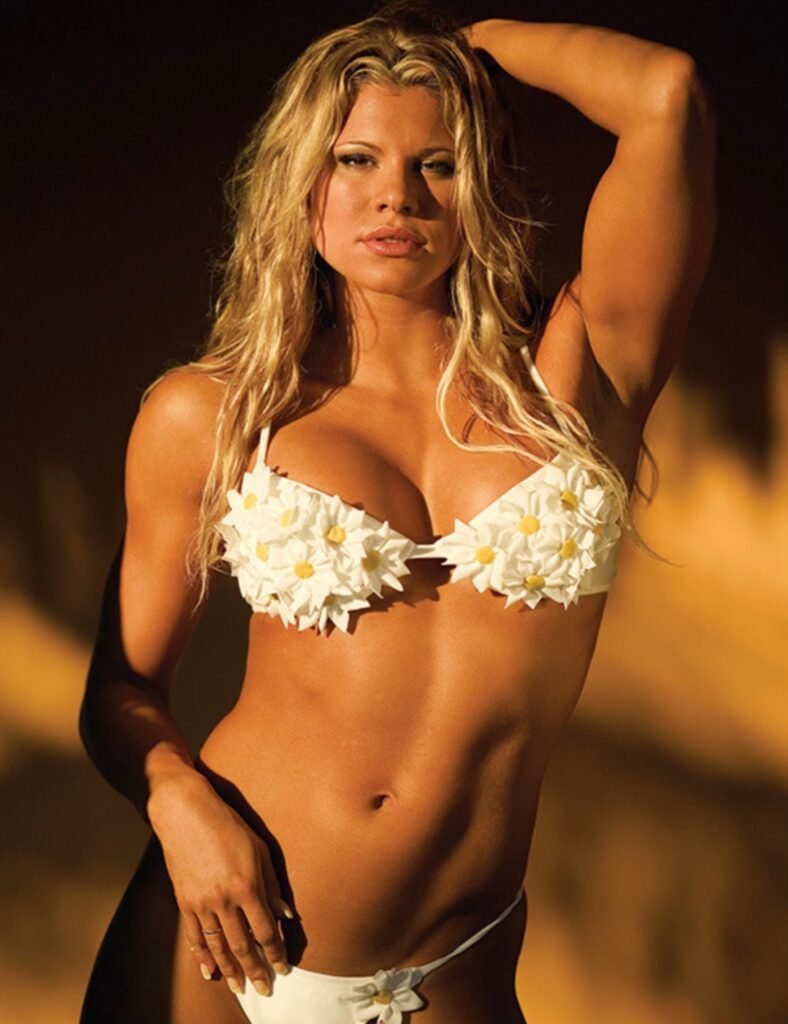
There’s a certain kind of symmetry to Jackie Gayda’s career—beauty and chaos, hope and wreckage. She walked into pro wrestling like a small-town prom queen let loose in a demolition derby, glitter in her hair, fury in her veins, and more spotlight than seasoning. And just like that, the world got to know her—not through triumph, but through the sound of a live audience collectively cringing.
It was July 8, 2002. Philadelphia. Monday Night Raw. A tag match, billed as just another curtain-jerker. Jackie Gayda and Christopher Nowinski vs. Bradshaw and Trish Stratus. On paper, it was nothing. In history? It became “that match.” Jackie missed cues like they were bills she couldn’t afford. Her timing was a paper umbrella in a hurricane. And when Trish tried to hit her with a second-rope bulldog, Jackie sold it ten seconds late and three feet off target. Jim Ross, God bless him, muttered, “Mercifully, it’s over.” America agreed.
But the wreck wasn’t the whole story. Because Jackie Gayda had guts. She took that embarrassment, swallowed it like bad bourbon, and walked into OVW with her chin up and fists clenched. In that Louisville gym, full of hope and mildew, she became a workhorse. Rico. Haas. Keibler. The Basham Brothers. She worked the angles. She got heat. She did what all real wrestlers do—she learned how to fail forward.
The WWE dressed her up as Miss Jackie, paired her with Rico (a glittery firework of a gimmick), then flung her into the tornado of early-2000s Diva drama. There were feuds with Sable and Torrie Wilson over Playboy covers, evening gown matches that made burlesque look like opera, and Halloween costume catfights that played like the dreams of a 13-year-old with a subscription to Maxim.
And yet, in that madness, Jackie found something like traction. She got engaged to Charlie Haas, teamed with him onscreen, then feuded with Dawn Marie in what felt like a fever dream of soap opera and stunners. They fought in pilgrim outfits, in Christmas gear, over neck braces and infidelities. It was all high camp and low blows, but Jackie played her part like a woman who knew the rules were rigged and decided to dance anyway.
Behind the curtain, she was tougher than the storylines let on. She got hit with Billy Kidman’s BK Bomb, wore that neck brace across a European tour, and showed up every week ready to sell a story—no matter how absurd. In the end, Haas betrayed her on-screen, Dawn Marie triumphed, and Miss Jackie was left in the ring, alone. Offscreen, it wasn’t so different. By 2005, WWE cut her loose.
But she wasn’t done. Wrestling’s underworld—indie halls and strip-mall shows—welcomed her with open arms and folding chairs. In places like Ballpark Brawl and Perros del Mal, Jackie reinvented herself. She beat Traci Brooks. She lost to Winter. She teamed with April Hunter and NY Knockout Nikki. For a time, she was Just Jackie. There was something poetic in that—no longer a product, just a person trying to fight her way into relevance.
Then came TNA. And with it, a rare chance at character. She marched onto Impact! and slapped the hell out of Jeff Jarrett, kicking off a storyline built on blackmail and backstage politics. She stood toe-to-toe with Gail Kim, got tangled in the weeds of Planet Jarrett, and even—briefly—hinted at a babyface turn. For one glorious stretch in 2005, Jackie Gayda was the most dangerous thing in TNA not wearing a title.
She won Knockout of the Year. She walked away from the game. She came back. She left again. There was a marriage to Haas, four children, a smoothie shop in Texas. There was a divorce. Life, messy and unpredictable, just like her career.
Jackie Gayda didn’t have the polish of a Stratus, or the mystique of a Lita. She wasn’t as smooth as Melina or as brutal as Beth Phoenix. What she had was rawness. A human vulnerability. She wasn’t a prototype. She was a work-in-progress that America got to watch live. She was botched finishes and bruised ambition. She was failure on camera, and fight in the shadows.
Her career is a cautionary tale, sure—but it’s also a quiet testament to stubbornness. In a world where one blown spot can kill a push, she stayed on the ride longer than anyone expected. She came in with a trophy from Tough Enough and left with scars that were earned, not scripted.