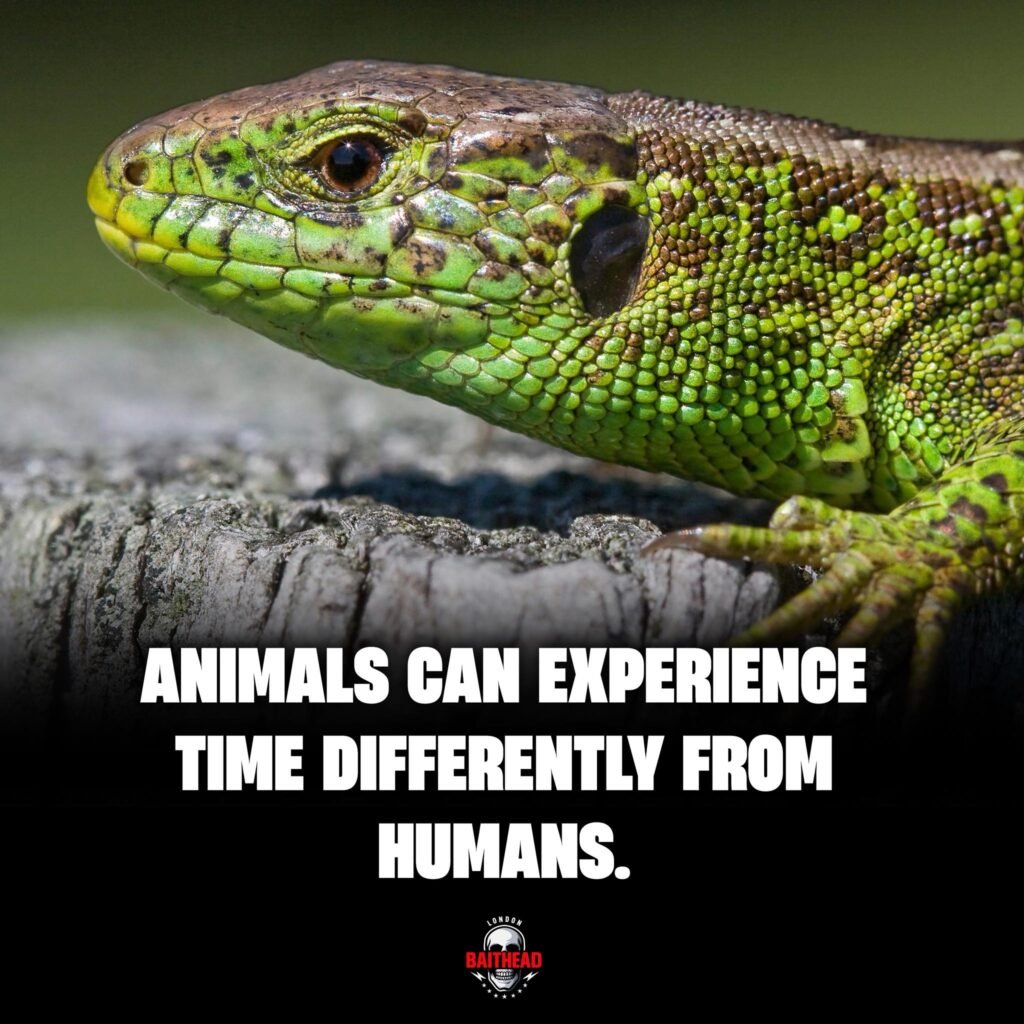
The image of a vivid green lizard resting quietly on a branch is paired with a fascinating statement: animals can experience time differently from humans. While the scene appears calm and still to us, science suggests that the way animals perceive the passage of time can be remarkably different from our own—and this difference shapes how they survive, hunt, and interact with the world.
Time perception is closely linked to how fast a brain processes information. Humans experience time at a moderate pace, but many animals process visual and sensory input much faster. For example, small animals such as insects, birds, and reptiles can detect rapid movements that humans might miss entirely. To them, what we perceive as a quick motion may feel slower and more detailed. This heightened perception helps prey animals evade predators and allows hunters to react with precision.
The lizard in the image represents this idea well. Reptiles rely heavily on motion detection to sense danger or opportunity. Their nervous systems are tuned to subtle changes in their environment, making them highly responsive to sudden movement. While a human might overlook a small shift in light or shadow, a lizard may perceive it as a significant event unfolding in time.
On the other hand, larger animals with slower metabolic rates may experience time in a more drawn-out way. Creatures such as turtles or large mammals often move deliberately, conserving energy, and their internal rhythms reflect this slower pace. This does not mean they are less aware—only that their experience of time is aligned with their physical and ecological needs.
Ultimately, the image reminds us that time is not a universal experience. It is shaped by biology, survival strategies, and sensory systems. While humans measure time with clocks and schedules, animals live in a more instinct-driven present—where a single second can mean the difference between life and death. Through images like this, we are invited to see the natural world not just as it looks, but as it may feel to those who live within it.